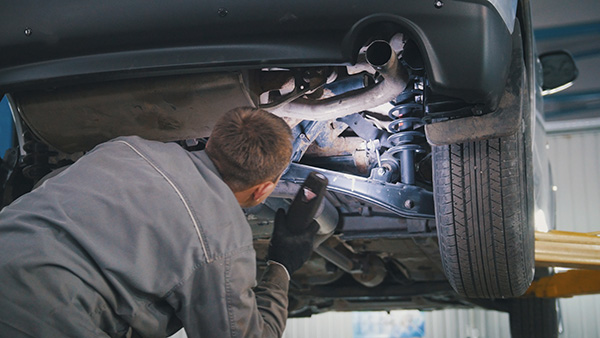
A car with worn suspension does not always announce itself with a single loud clunk. Sometimes it just starts feeling tired. The steering needs tiny corrections, the front end dips more than it used to, or the tires start wearing in a pattern that looks wrong.
That is usually the car telling you the chassis is moving more than it should.
Suspension, steering, shocks, and struts all work together. When one part wears, the whole vehicle can feel less settled. You may still get where you are going, but the car does not feel as planted, quiet, or predictable.
When The Ride Starts Feeling Loose
A worn suspension often shows up first in the way the vehicle feels over bumps. Instead of taking one hit and settling, it keeps moving. The body may bounce after dips, rock after lane changes, or feel floaty on the highway.
Shocks and struts are the main parts that control that motion. Springs hold the vehicle up, but shocks and struts dampen the spring movement. When they wear out, the tires spend less time firmly pressed into the road. That affects comfort, braking, and control, even if the car still feels drivable.
Clunks, Rattles, And Knocks Over Bumps
Noises over rough roads usually mean something underneath has loosened, worn out, or lost its cushion. Sway bar links can rattle. Control arm bushings can clunk. Ball joints can knock. Strut mounts can make a dull thud when the vehicle hits a driveway entrance.
The sound pattern helps. A sharp clunk from one corner points in a different direction than a light rattle across the front end. If the noise happens mostly at low speed over bumps, suspension hardware moves higher on the list. If it changes while turning, steering parts need a closer look, too.
Steering That Wanders Or Feels Vague
A healthy steering system should feel steady. If you are constantly correcting the wheel to stay in your lane, something is off. Tire pressure, alignment, tie rods, control arm bushings, ball joints, and steering rack issues can all create that wandering feeling.
Sometimes the steering wheel sits a little crooked after hitting a pothole. Other times, the car follows grooves in the road more than it used to. That loose, delayed feel is not normal aging; you just have to accept it. It is a sign that the tires, suspension, or steering parts are no longer holding the vehicle’s geometry as cleanly as they should.
Tire Wear Tells The Truth
Tires are often the first place suspension problems become visible. A worn shock can let the tire bounce, creating cupped or scalloped tread. Poor alignment can chew up the inside or outside edge. Loose steering parts can create a feathered tread that feels sharp one way when you run your hand across it.
Here are the tire clues worth checking:
- Inside edge wear that shows up before the rest of the tread is low
- Cupped or choppy patches around the tire
- One tire is wearing out faster than the others
- A steering wheel shake at certain speeds
- Tires that get noisy even though they still have tread
If new tires are installed without fixing the cause, the new set can wear the same way. That gets expensive fast.
Braking And Suspension Are Connected
Suspension wear can be evident during braking. If the front end dives hard when you stop, the front shocks or struts may not be controlling weight transfer well. If the steering wheel shakes when braking, the cause could be brake rotor wear, but loose front-end parts can make the shake feel worse.
A worn suspension can also make the car feel unsettled during a quick stop. The tires need steady contact with the road to brake well. If shocks, struts, bushings, or joints are letting the wheels move around too much, braking can feel less confident than it should.
We look at brakes and suspension together for that reason. One symptom can have multiple sources.
Potholes And Curbs Leave Clues
A hard pothole hit can bend a wheel, knock the alignment out, damage a tire, or stress suspension parts. A curb hit can do the same thing at parking-lot speed. The vehicle might not feel terrible right away, but the damage can show up later as tire wear, pulling, or a new clunk.
After a hard hit, pay attention to the steering wheel position, vibration, tire pressure light, and whether the car pulls. If any of those changed, schedule an inspection. Regular maintenance is also a good time to catch torn boots, cracked bushings, leaking struts, and loose joints before they start eating tires.
Get Suspension And Steering Repair In Martinez, CA, With Hagin's Automotive
If your car is clunking, bouncing, wandering, pulling, or wearing tires unevenly, Hagin's Automotive in Martinez, CA, can check the suspension, steering, shocks, and struts and explain what is actually worn.
Book a visit and get the car feeling steady again without replacing parts that are still doing their job.