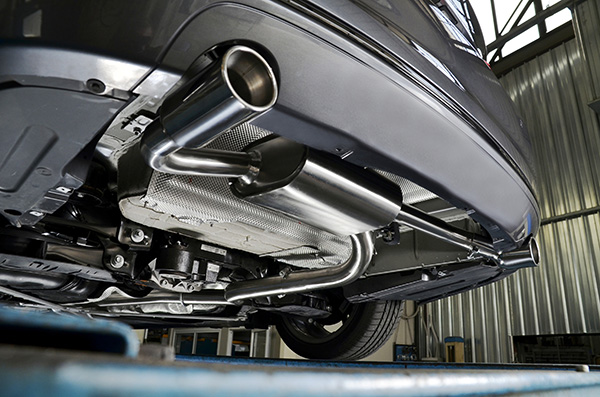
An exhaust rattle that shows up when you press the accelerator can be surprisingly hard to pin down from the driver's seat. At idle, the car may sound normal, but once the engine is under load, a metallic buzz or knocking noise starts coming from under the vehicle.
Acceleration changes engine movement, exhaust flow, and vibration at the same time. That is why the source can be anything from a loose heat shield to a broken hanger or an internal failure inside the muffler or catalytic converter. The way the noise reacts to engine speed gives us useful clues.
Loose Heat Shields Are a Frequent Source of Metallic Rattles
Heat shields are thin pieces of metal positioned around the exhaust to protect the floor, fuel system, wiring, and nearby components from high temperatures. Because they are lightweight, a small amount of looseness can make plenty of noise.
Mounting points can rust, washers can pull through the shield, or the metal can crack around a fastener. The result is often a sharp buzz at a narrow RPM range. You press the accelerator, the engine passes through that frequency, and the shield vibrates loudly for a second before becoming quiet again.
A Broken Exhaust Hanger Lets the System Move Too Far
The exhaust hangs underneath the vehicle on rubber isolators, brackets, and hangers. These parts support the system while allowing some movement as the engine shifts and the exhaust heats up.
If a rubber hanger tears or a metal bracket breaks, the pipe can swing farther than intended during acceleration. It may hit a crossmember, suspension part, heat shield, or the underside of the body. At our shop, we check exhaust clearance while looking for shiny contact marks that show exactly where two parts have been touching.
Engine Movement Can Push the Exhaust Into the Body
The engine does not stay perfectly still when you accelerate. Its mounts allow controlled movement as torque increases. If an engine or transmission mount becomes weak, that movement can become excessive.
A perfectly solid exhaust system can then begin hitting something nearby only when the engine is under load. This is one reason a rattle during acceleration shouldn't automatically be blamed on the muffler. We look at mount movement and exhaust clearance together, especially when the noise is strongest during takeoff or a hard throttle application.
Something Inside the Muffler Can Break Loose
Mufflers contain chambers, tubes, and baffles that control exhaust noise. If one of those internal pieces breaks away, it can rattle inside the outer shell even though the muffler looks fine from the outside.
The sound often changes with RPM because exhaust pulses and vibration move the loose part differently as engine speed rises. Tapping the muffler during an inspection can sometimes reveal a loose internal piece. If the rattle comes from inside a sealed muffler, replacing that section is usually more practical than trying to repair the internal structure.
A Catalytic Converter Can Rattle Internally Too
Inside the catalytic converter is a ceramic or metallic structure coated with materials that help reduce harmful exhaust emissions. If that internal substrate cracks or breaks apart, pieces can move around inside the converter housing.
Signs that deserve attention include:
- Metallic rattling that increases with acceleration
- Noise coming from the converter area
- Reduced engine power
- A check engine light
- A sulfur-like exhaust smell
- Excessive heat around the converter
Don't replace a damaged converter until we understand why it failed. Misfires, excessive oil consumption, or an overly rich fuel mixture can overheat a converter and damage the replacement as well.
Rust Can Weaken Exhaust Clamps, Flanges, and Brackets
Exhaust hardware spends its life exposed to water, dirt, and road debris while constantly heating and cooling. Over time, clamps can loosen, flange edges can deteriorate, and welded brackets can crack.
A joint that loses support may rattle before it develops an obvious exhaust leak. Once a flange or pipe begins separating, you might also hear ticking or a deeper exhaust note when accelerating. Surface rust alone is common, so we focus on whether the metal has actually weakened or the connection is moving.
Listen for When and Where the Noise Happens
The conditions that produce the rattle can help narrow the search. A noise that happens at the same engine RPM even when the vehicle is parked points us toward something responding to engine vibration. A sound that appears mainly while the vehicle is moving under load can involve engine movement, exhaust contact, or driveline components.
Useful details include whether the noise is worse when the engine is cold, during hard acceleration, over bumps, or at one specific RPM. Those observations help us reproduce the complaint instead of shaking every piece underneath the car and hoping something rattles.
Do Not Let a Small Rattle Hide a Larger Problem
Many exhaust rattles turn out to be relatively simple problems such as a loose shield or worn hanger. Others signal a broken converter, failed mount, rusted connection, or exhaust section that is close to separating.
Regular maintenance gives us chances to spot loose brackets and corrosion before they start making noise. If the rattle is accompanied by exhaust fumes, loss of power, a check engine light, or a hanging pipe, it should be checked sooner rather than later.
Get Exhaust Repair In Martinez, CA, With Hagin's Automotive
If your exhaust rattles, buzzes, or knocks when you accelerate, Hagin's Automotive in Martinez, CA, can inspect the heat shields, hangers, mounts, pipes, muffler, catalytic converter, and exhaust connections to find the source of the noise.
Schedule an exhaust inspection before a loose or damaged component turns into an exhaust leak or leaves part of the system hanging underneath the car.